c. 1500 BCE
Kyphi
What does it smell like to speak to a god?
This is what you could call 'ritual chemistry'. Perhaps the first compound perfume which was not worn, but burned at dusk.
Kyphi is one of the oldest compound perfumes which has had a formula survive. It's made of sixteen ingredients and was burned in temples at nightfall as an offering to the gods.
"Kyphi has a sweet smell slowly exhaled. When burned it lulls to sleep, alleviates anxiety, and brightens dreams."
Plutarch, Isis and Osiris, c. 100 CE.
Cultural context
Kyphi was the sacred incense of ancient Egypt. It's a compound of sixteen ingredients including honey, wine, raisins, myrrh, frankincense and calamus, burned in temples at nightfall as an offering to the gods. It's the oldest compound perfume whose formula survives. None of its sixteen ingredients were chosen randomly. It came from experience across generations of temple physicians who had shown that its combination of ingredients produced a calming effect on the nervous system. But Kyphi wasn’t just symbolic or ritual incense. It also likely had respect for its genuine medicinal properties, especially as an antimicrobial agent.
Molecules
Beta-elemene, curzerene (myrrh) —anxiolytic, anti-inflammatory. Alpha-pinene (juniper) — anxiolytic, documented in trials. Cinnamaldehyde (cinnamon) — antimicrobial, anti-inflammatory. Asarone (calamus) — psychoactive at high dose.
In the world
The Book of the Dead and the chemistry of the afterlife
Egyptian funerary texts describe aromatic preparations with the same precision applied to architectural measurements. The anointing oils were not symbolic. They were functional. Preserving, purifying, carrying something across a threshold the living could not follow.
The ancient Egyptians used aromatic preparations practically in burial and the oils and resins used to anoint and preserve the body were the same materials used in temple incense. Myrrh, frankincense, kyphi.
When Howard Carter opened Tutankhamun's tomb in 1922, the sealed alabaster vessels still contained traces of their original contents after three thousand years. The smell was still chemically present which is extraordinary.
The nose
Dioscorides
c. 40–90 CE. Greek physician, author of De Materia Medica which was the foundational text of pharmacology. His entries on myrrh, frankincense, iris, and spikenard are the most detailed surviving account of the medicinal use of perfumery materials in the ancient world. Today it is replaced in medical education contexts by the term 'pharmacology'.
Now
No one has made a fully authenticated reconstruction of Kyphi. But the Cairo Museum has the actual vessels found in Tutankhamun's tomb. Some experimental archaeologists have attempted reconstructions and there's a project at the University of Oxford and one in Germany. The closest you might get commercially is something like Papyrus by Comme des Garçons, or Serge Luten's Arabie.
You can burn myrrh resin and labdanum together to get close.
The anxiolytic effect of alpha-pinene (juniper) and the beta-elemene in myrrh are documented in modern clinical trials. The Egyptians were burning these materials at nightfall specifically because they produced a calm, dream-adjacent state. We now know why chemically. And people are still buying incense, burning it at dusk, for the same thing. The impulse to use smell to alter conscious states hasn't changed. We just call it aromatherapy or aromascience today.
Plant / material
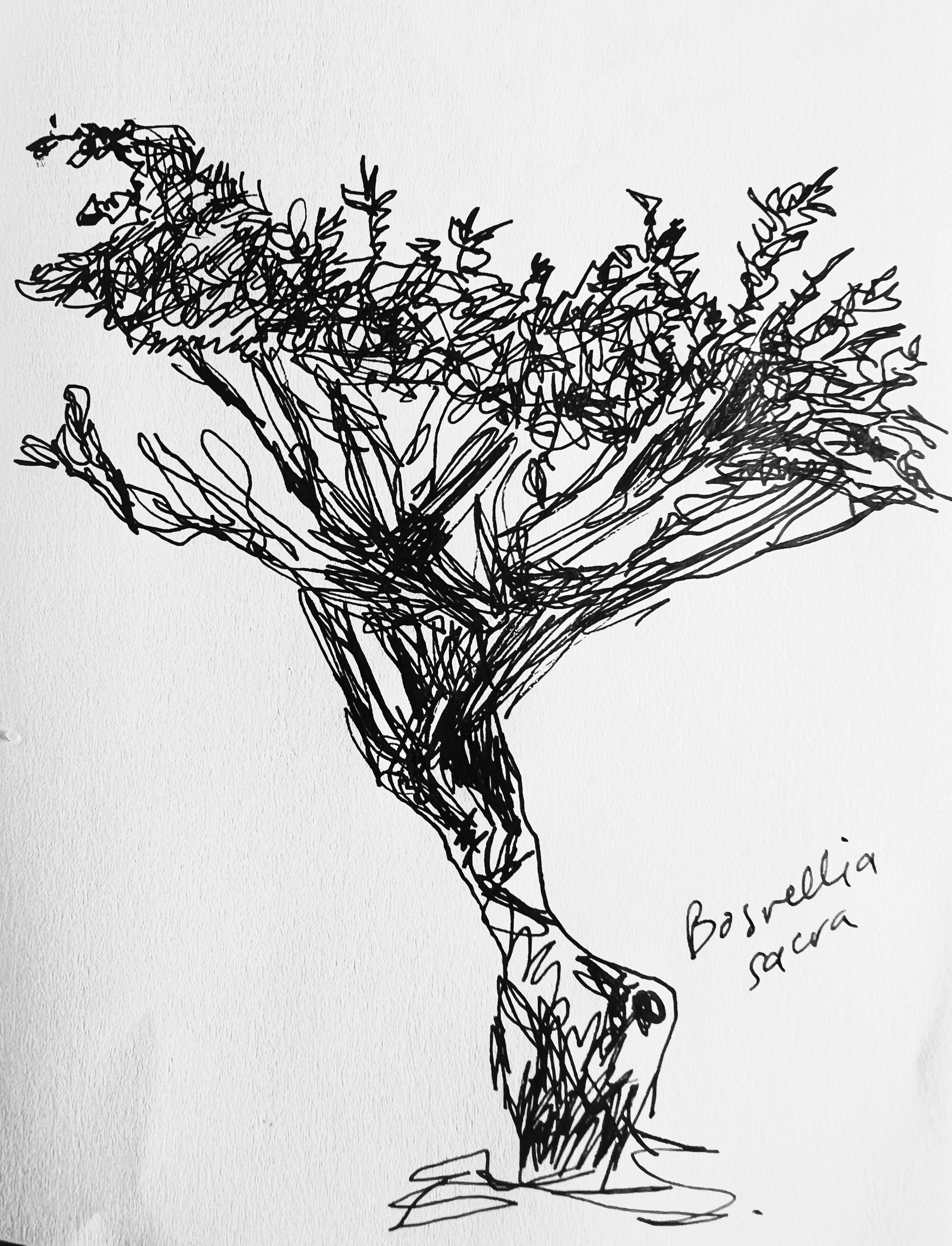
Frankincense (Boswellia sacra), Cassia (Cinnamomum cassia), Cinnamon Cinnamomum verum), Juniper berries (Juniperus communis), Myrrh (Commiphora myrrha), Calamus (Acorus calamus). Labdanum (Cistus ladaniferus, the rock rose), wine, raisins and honey.
The ancient Egyptians did not have the term we know today as a double-blind trial but they were very good at observation. What we now call “antimicrobial,” they understood as substances that kept wounds from spoiling, that slowed decay, or purified the air.
Resins like frankincense (Boswellia sacra) and myrrh (Commiphora myrrha) were not chosen at random for their scent. They were chosen because, over time, they showed evidence to work.