1934
Tender is the Night as a Scent Story
What is it like to imagine the scent of F. Scott Fitzgerald's novel?
A barber shop and a Mediterranean garden
Sometimes beauty gives back images of one's best thoughts
F. Scott Fitzgerald, Tender is the Night
Cultural context
F. Scott Fitzgerald wrote to our olfactive senses in many of the pages of Tender is the Night. This novel of a couple's marriage was written at a time when the public display of scent had turned private.
Men were now shaving at home and the barber shop visit was instead a signal of status, a special trip in the same way women might go for a facial today. As a result there was a fading tension between bathroom scent and public scent which was signalled in the Gillette advertisements at the time.
"There is something wholesome about the Gillette shave. It does not reek of violet water and pomades' claimed one King C Gillette advert.
But even so, the book's protagonists, Dick and Nicole Diver, would frequent the barber together for haircuts and shampoos. Fitzgerald talks of them being 'washed in the perfumed breeze of the fans," and for Nicole the hairdresser visit became a relatable "wasteful interval surrounded by faintly sweating lip-rouge and cologne," while in the next room Dick "dozed under an apron and a lather of soap."
The scents in the novel translated to the garden to in their home Villa Diana. The Villa was one of Fitzgerald's great symbolic settings on the French Riviera, inherited by Nicole from a family fortune. Like a lot of Fitzgerald's writing it represented a carefully curated paradise that read like tissue more than paper, threatening to disintegrate in front of the reader's eye. It was apparent it could not last. It was early in the book that its garden was bought to life.
The description of the garden at the Villa takes florals and heliotrope into the imagination. There was an 'intangible mist of bloom' which describes so aptly a mid-summer evening on the Mediterranean coast; fig trees, nasturtiums, iris tangled, peonies that were kaleidoscopic and others massed in pink clouds. There were mauve stemmed roses with a fragility of 'sugar flowers in a confectioners window' and a vegetable garden in a 'fuzzy green light', a garden that Dick described Nicole as 'nagging at all the time."
In Tender Is the Night, Fitzgerald explicitly mentions the fragrance house Chanel in a passage about Nicole Diver.
"She put on the first ankle-length day dress that she had owned for many years, and crossed herself reverently with Chanel Sixteen." Fitzgerald's 'Chanel Sixteen' appears to be a fictitious perfume, but the reference reflects Chanel's cultural significance in the interwar years. Chanel signalled a new kind of femininity as, while many men still favoured traditional colognes, women were embracing innovative fragrances. This was led by the huge success of Chanel No. 5, with its use of aldehydes and synthetic materials and shorthand for independence and style for women like Nicole.
Molecules
The scent from the barber's chair described earlier was a fragrance composition of its own in that period. Always with bergamot at the top, a citrus that was bright and the scent of clean linen and good intentions. Gillette was selling an uncomplicated note that was masculine in the way that era understood masculinity. In a backlash against the ravages of war, masculinity became clipped, contained and low key.
In those years after the First World War, having witnessed the devastation that could emerge when human passions were unleashed on an industrial scale, Western society increasingly prized restraint, rationality and self-control. The clean-shaven face became part of that visual language. It presented masculinity not as wildness or instinct, but as something managed and civilized and with that, scent followed.
There would have been neroli and bitter orange blossom, carrying something that belonged less to the bathroom and more to the skin. The Divers' world in Fitzgerald's novel ran on this tension. Petitgrain from the leaves and twigs of an orange tree would have been in the Barber's cream with a woody, green and faintly medicinal base.
Lavender would also have been the backbone of the barbershop across the whole interwar period. Today it is associated with grandmotherly scents but in 1930 it symbolised the European tradition.
In the world
The last of the summer wine
The Divers lived in the last good summer of something for that period, before the Great Depression. The garden at Villa Diana read already as a memory while they were still in it as Fitzgerald had set it largely in the 1920s. Tender is the Night was published in April 1934. In Germany, Hitler had been Chancellor for fourteen months and there was the rise of Fascim in Europe. In France, the Popular Front was two years away and in America, the Depression had been running for five years and Prohibition had just ended .
Now
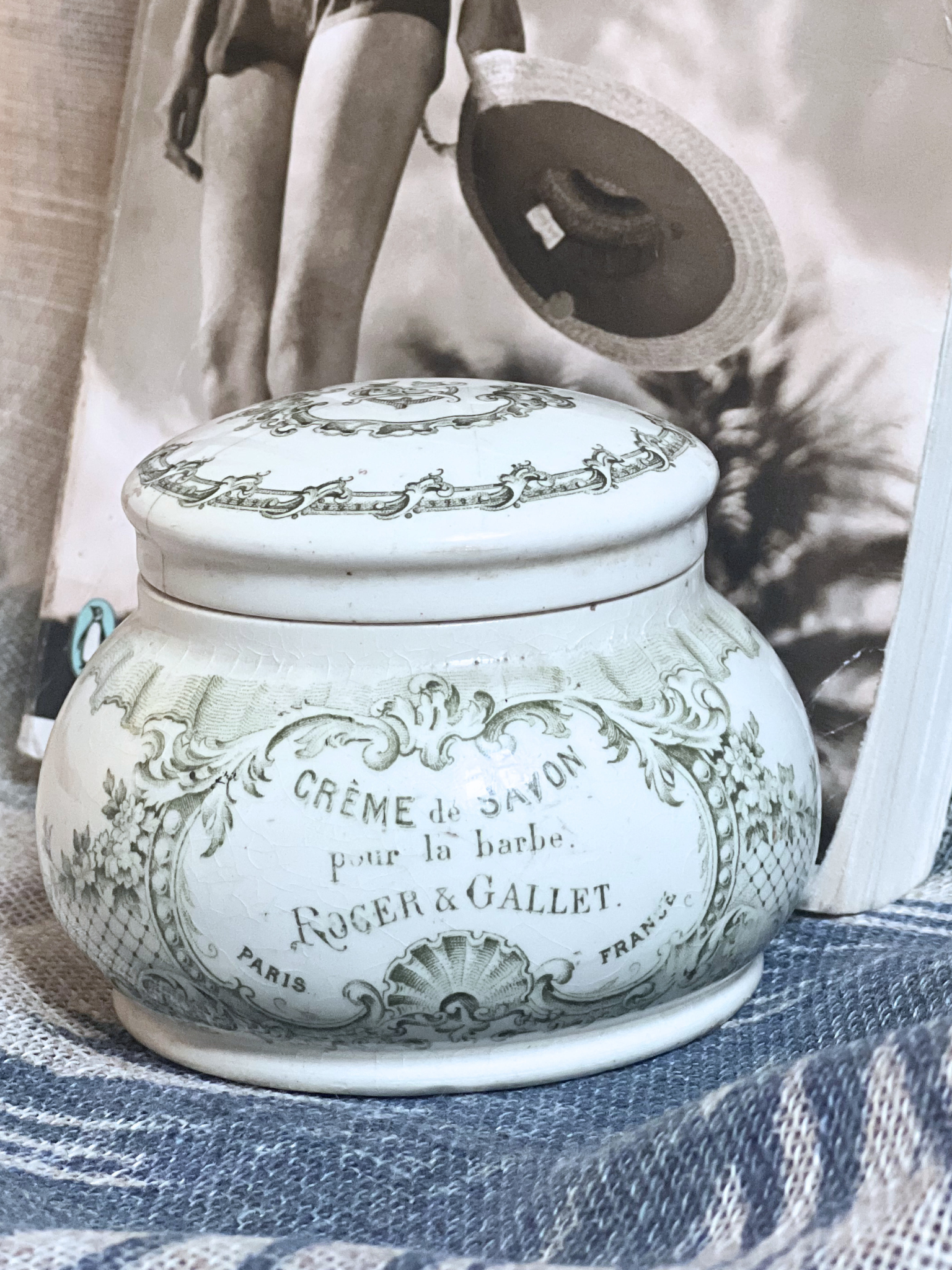
The Roger & Gallet ceramic pot was discontinued after L'Oréal acquired the house in 1984, when multinationals were claiming heritage assets. Today Roger & Gallet is a mid market French pharmacy brand. The connection to Farina's original cologne formula is largely marketing heritage at this point and the Eau de Cologne Extra-Vieille still exists but likely a shadow of what it was.
Plant / material
What was in the colognes and shaves of this time?
Bergamot or Citrus bergamia was the top note of almost every cologne or barber shave of the eighteenth century onwards. Begamot is an inedible citrus grown almost exclusively in Calabria, southern Italy and its value lies in the rind which is cold-pressed in oil. It's the plant that makes Earl Grey tea and half of all classic colognes. Fitzgerald's Riviera is classic bergamot weather. It's there across the pages in that coastal, citrus-scented air.
Citrus aurantium is able to give three distinct materials depending on which part of the tree you use.
The blossom is known as neroli, named after a seventeenth-century Italian princess who wore it on her gloves until the scent became inseparable from her. It is narcotic in concentration and slightly animalic underneath all that white flower brightness but delicate enough for the skin.
The hills around Grasse have grown bitter orange for neroli for three hundred years. From the French House of DeuxPies you can drive there in forty minutes and it's the same plant, the same distillation, the same smell that would have been on Dick Diver's barber's hands.
Petitgrain is the leaves and twigs from the bitter orange, rather than the blossom. Where neroli is soft and slightly on the edge, petitgrain is green and has that woody, dry and faintly medicinal roundness. Adding a petitgrain note keeps a barbershop cologne from becoming a perfume.
Lavender we mention last because in this context it needs no introduction. Lavandula angustifolia grows wild on the limestone hills above The House of DeuxPies. In 1934, when Fitzgerald was finishing the novel in a rented villa not far from where Nicole Diver's garden bloomed, lavender was not yet the cliché it would become today. It was simply the smell of the south of France. It was clean and certain while still as uncomplicated as it is today.
These were the essence of a barber cologne.