
1977
The Memory of Plants in Craft
Salt glaze, studio pottery and the persistence of botanical memory in clay
Botanical decoration on pottery has changed meaning across centuries, from Chinese celadon and Ottoman Iznik ware through to French faience and the Victorian botanical revival, before arriving at the twentieth century studio pottery movement. In this piece we satellite around Le Don du Fel, the salt glazed stoneware workshop founded by Nigel and Suzy Atkins in rural France in 1977, as an example of one of those changes in meaning.
True appreciation of beauty cannot be fostered by ignoring practical handicrafts.
Soetsu Yanigi in The Beauty of Everyday Things
Cultural context
Pottery and ceramics have always carried plants. Sometimes they were painted, sometimes more moulded into relief, or a stem drawn through wet slip before the kiln closed.
Across thousands of years and many ceramic traditions, flowers and leaves have persisted in a way that almost no other motif can match. But as with art, each tradition has made that motif from its time mean something specific to reflect it.
In Chinese celadon (a type of green-glazed ceramic made in China), the lotus carried Buddhist meaning as a symbol of purity, long before any European collector encountered it. Ottoman Iznik potters worked for the imperial court and developed a precise vocabulary to represent tulips, carnations, hyacinths and roses, exact enough that a dish from that era can still be dated by the combination it uses. Both traditions continued on their own terms for centuries, independent of whether Europe was paying attention.
Europe did start to play close attention, and not always honestly. As nineteenth century industrialisation gathered pace, factories such as Minton and Wedgwood filled middle class British homes with botanical and chinoiserie ornament, much of it borrowing directly from the Chinese and Ottoman visual languages already described, stripped of their original religious and courtly meaning and resold as generic signifiers of the exotic. This is the same extraction where empires separated plants, and the visual languages built around them, from the people who gave them meaning, to then patent, rename and sell the result back to the world as luxury.
The twentieth century studio pottery movement was different. It positioned itself against that industrial model, but its own origins were collaborative rather than singular. Bernard Leach founded the movement most visibly from Britain, but the philosophy behind it was built with Yanagi Soetsu, the Japanese philosopher who coined the term mingei for the beauty of ordinary handmade objects, and Hamada Shoji, the potter who became Leach lifelong friend and co founder, choosing to leave Japan and help establish the Leach Pottery in St Ives in 1920.
What emerged was not a British idea exported outward, nor a Japanese philosophy imported wholesale, but a genuinely shared position built between England and Japan which was that clay should stay legible as clay, and that firing, ash and salt were collaborators in the work rather than problems to be engineered away.
It was into this movement, more than seventy years old by the time they arrived, that Nigel and Suzie Atkins founded Le Don du Fel in 1977, not by choice alone but because they had been priced out of setting up a pottery in England. Suzie came to clay at age twenty seven, through an evening class taken almost by accident, in a craft that had only recently begun offering women a route to serious professional standing rather than domestic hobby status. Nigel brought industrial design training from the Royal College of Art. Their workshop is one small, specific instance within a much larger and still ongoing set of traditions, not its culmination.
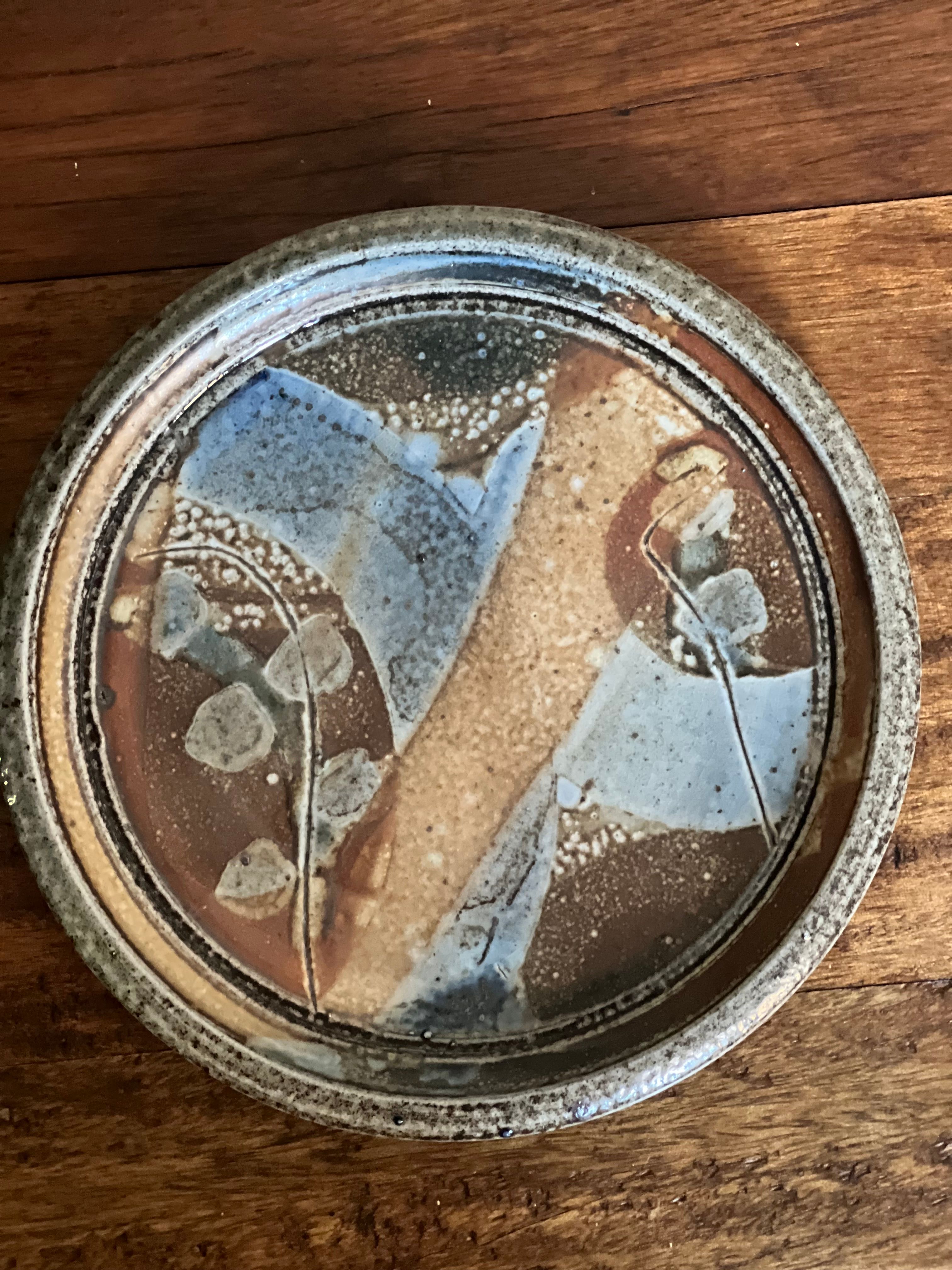
Molecules
Nigel and Suzy Atkins' work is rooted in salt glazing, a process that deliberately surrenders part of the finished surface to chemistry. At peak temperature, salt is thrown into the kiln. It vaporises and reacts with the silica in the clay to form the glaze itself. The potter controls the form, the firing and the timing, but never the exact surface and fire, salt and atmosphere complete what the hand started.
In the world
The World in 1977
In April 1977, the same year Nigel and Suzy Atkins moved into a farmhouse in the Cantal with no electricity or running water, the Apple II was introduced to the public at the West Coast Computer Faire in San Francisco. It went on sale that June, colour graphics and a keyboard packaged into a single machine, and personal computing began its move from hobbyist workshops into ordinary homes.
British television was, at the same moment, gently laughing at the same impulse the Atkins were living without irony. The Good Life, first broadcast in 1975 and still running in 1977, followed a suburban couple in Surbiton attempting total self sufficiency, keeping pigs and growing vegetables to the horror of their neighbours. That same year, the Sex Pistols released God Save the Queen into the middle of the Queen Silver Jubilee celebrations, a record built on the same rejection of polish and packaging, if aimed at the monarchy rather than the grocer shelf.
Nobody was choosing between these things exactly. But 1977 held both directions at once. A machine that would eventually make precision cheap and instant, and several unrelated attempts, comic, punk and domestic, to keep something rougher and slower alive.
Now
Perhaps in a digitised world where precision is more easily attained, the glitches that come with craft are being re-embraced.
Plant / material
Clay. Earth.